
More on the Suphra blog, 3 + 3 recipe roulette, cook mode with YouTube, and pricing.
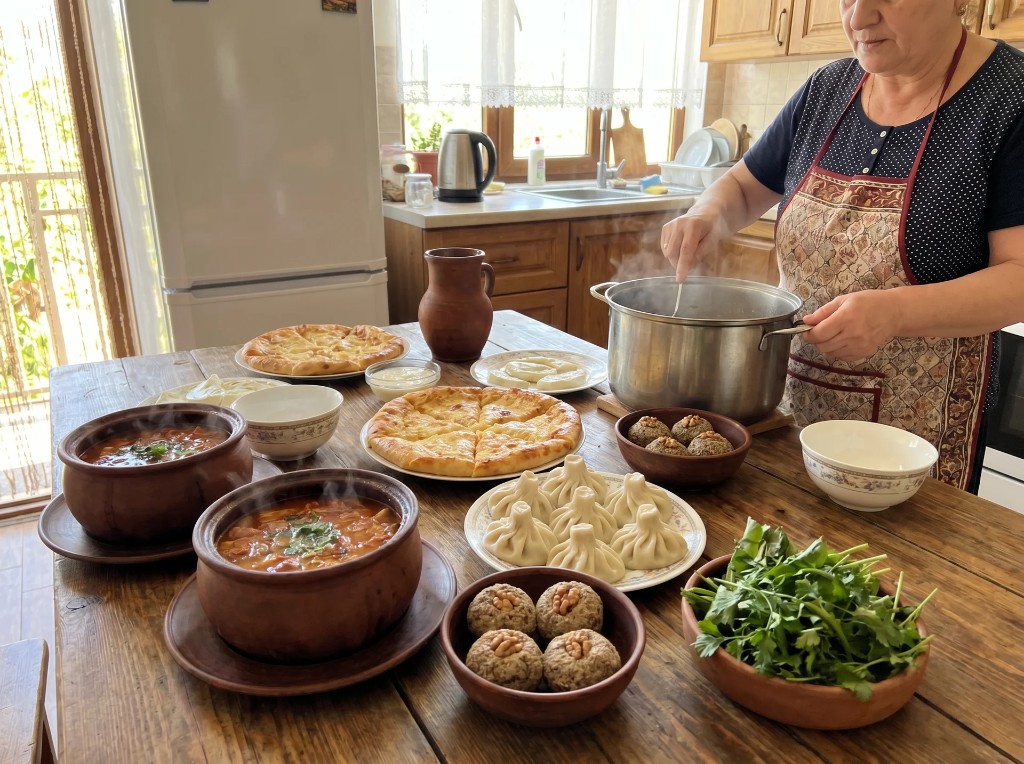
The Georgian word supra means table — but not just any table. It's the feast, the gathering, the ritual of abundance. A Georgian supra can have forty dishes. The tamada (toastmaster) orchestrates toasts that go on for hours. There's always more food than anyone could possibly eat.
The app is named Suphra for exactly this reason: it's built around the idea that your kitchen should feel like a place of possibility, not a source of anxiety. And Georgian cuisine — with its layered spices, preserved ingredients, walnut-heavy sauces, and ancient fermentation traditions — is one of the richest testbeds for what an AI recipe app can actually do.
Why Georgian cuisine is uniquely suited to scan-first cooking
Most Western recipe apps are built around a narrow pantry assumption: olive oil, pasta, canned tomatoes, chicken breast. Georgian cooking operates on a completely different ingredient logic. The building blocks are things like:
None of these appear in a standard Western recipe database. And yet, if you have tkemali, walnuts, and a bunch of spinach sitting in your fridge, Suphra's AI recipe engine can tell you exactly what to make — because it reasons from ingredients, not from a fixed recipe library.
Traditional Georgian dishes you can cook from leftover ingredients
Georgian cuisine has a long tradition of using everything. The country's geography — mountains, valleys, the Black Sea coast — meant that different regions developed hyper-local ingredient traditions. Nothing was wasted. Here's how some classic dishes map to the "random stuff in the fridge" problem:
Pkhali — the original "clean out the fridge" dish
Pkhali (ფხალი) is a family of cold appetizers made by combining any cooked or raw vegetable with a walnut-garlic-herb paste. Spinach pkhali, beet pkhali, bean pkhali — the vegetable almost doesn't matter. If you have walnuts and garlic, you can make pkhali from nearly anything. Scan your vegetable drawer into Suphra and it'll suggest the right version for what you have.
Lobiani — beans, bread, and nothing else needed
Lobiani (ლობიანი) is a bean-filled bread from the Racha region — hearty, warming, and made almost entirely from pantry staples. Kidney beans, onion, butter, flour. If you have those, you have dinner. An AI cooking assistant won't overcomplicate it.
Chakapuli — the spring herb bomb
Chakapuli (ჩაქაფული) is a spring stew of lamb or veal with masses of tarragon, tkemali, spring onions, and white wine. It's traditionally an Easter dish — but it's also a perfect example of a recipe built entirely around what's in season. If you have tarragon that's about to wilt and tkemali in the fridge, scanning them into Suphra will surface this immediately.
Soko Ketsze — mushrooms in a clay pan
Mushrooms, butter, cheese. That's most of soko ketsze (სოკო კეცზე). Sulguni cheese melted over pan-fried mushrooms — one of the simplest, most satisfying dishes in the Georgian repertoire. Three ingredients. Under twenty minutes. Suphra's scan-first flow was built for moments exactly like this.
Georgian pantry staples worth always keeping stocked
If you cook Georgian food regularly — or want to — there's a core pantry that unlocks hundreds of dishes. Suphra can work with all of them:
The core pantry: walnuts (for sauces, pkhali, satsivi), tkemali (sour plum sauce, used like ketchup), khmeli suneli (the spice blend — fenugreek, coriander, marigold, more), sulguni cheese (salty, stretchy, melts beautifully), tarragon (fresh or dried, essential for spring dishes), pomegranate seeds (for garnish and acidity), grape leaves (for wrapping, especially in tolma), and cornmeal (for mchadi, Georgian cornbread).
Scan any combination of these into Suphra's ingredient scanner and you'll get real Georgian recipe ideas — not generic suggestions that happen to include walnuts.
Tkemali keeps for months in the fridge. If you spot it going unused, scan it with Suphra alongside whatever meat or vegetables you have — it works as a marinade, a sauce, and a cooking liquid all at once.
The supra tradition and the modern kitchen problem
There's an irony at the heart of Georgian food culture. The Georgian supra tradition — recognized by UNESCO as part of the intangible cultural heritage of humanity — is built on abundance, hospitality, and the idea that food is never just fuel. It's a social act. A spiritual one, even.
And yet, in modern Georgian households (as in every household globally), a huge amount of food gets thrown away. The supra table was built on the principle of using everything the season gave you. That principle got lost somewhere between the Soviet-era food system and the modern supermarket.
Suphra is, in a small way, a return to that logic: start from what you have, not from what a recipe demands. It's less about AI and more about restoring the kind of kitchen intuition that Georgian grandmothers have always had — just faster, and available at 11pm when you're staring at a fridge full of question marks.
Have Georgian ingredients and no idea what to cook?
Scan your tkemali, walnuts, tarragon, sulguni — or anything else — and get AI recipes built around what's actually there. Three options instantly, three more if the vibe is wrong.